
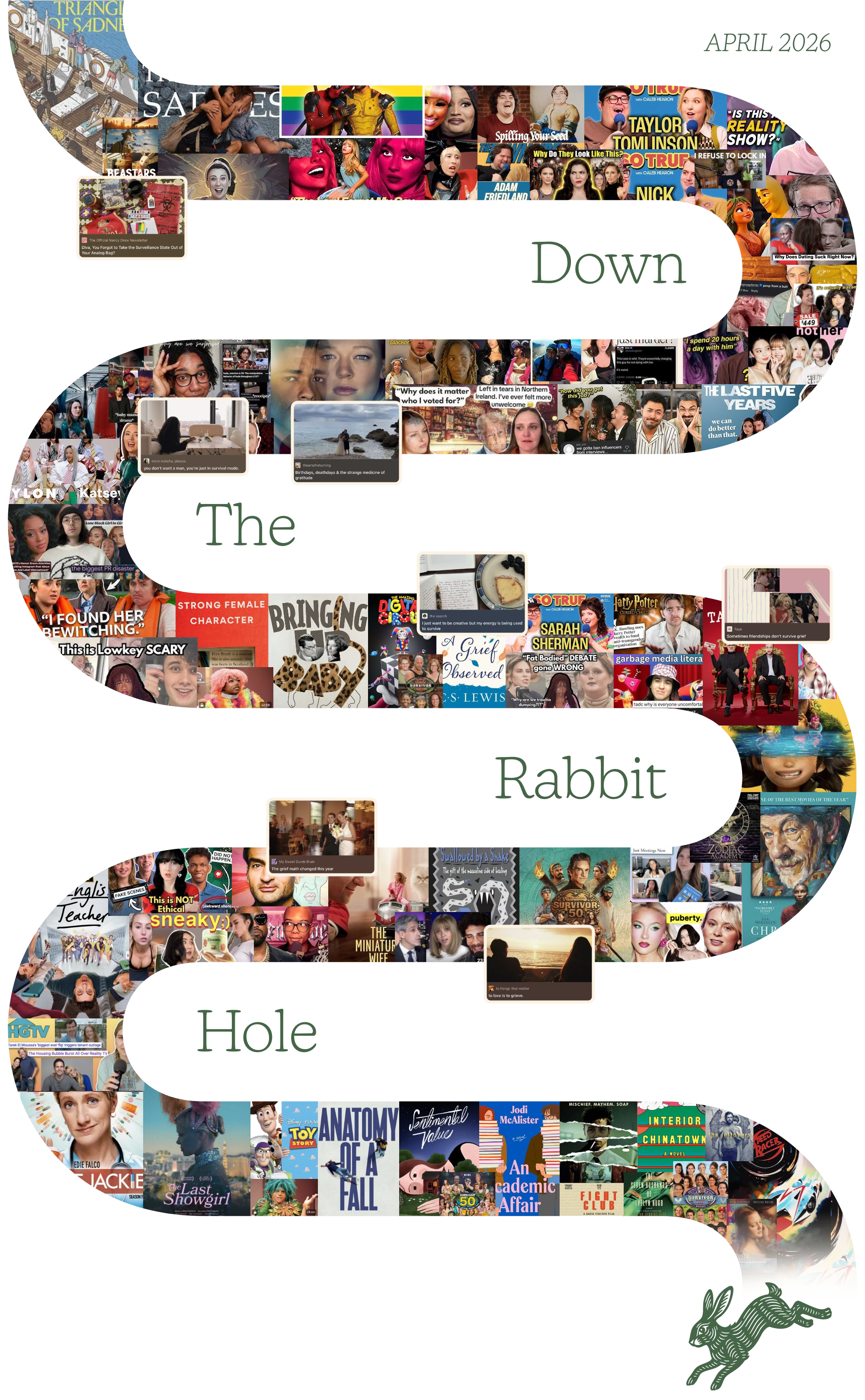
Highly inspired by sihaam’s spiral series on Web Weaving 🌀, I embarked on the journey of a media post-mortem. Taking account of the media I’ve consumed this past month was more rewarding than I had expected, and really encouraged more mindfulness in my selection, consumption, and consideration afterwards.
Feels weird to be posting an April wrap-up halfway through March. The truth is, I’ve had the graphics created for this for ages, but I’ve been held back by the writing portion, which is all the more reason that this exercise is useful for me right now. I’m getting a little too used to consumption, and I’m out of practice with analysis— drawing my own conclusions, snatching what would otherwise be passing thoughts in order to write them down and examine them in a tangible, more intentional way.
Utopian & Dystopian Technology
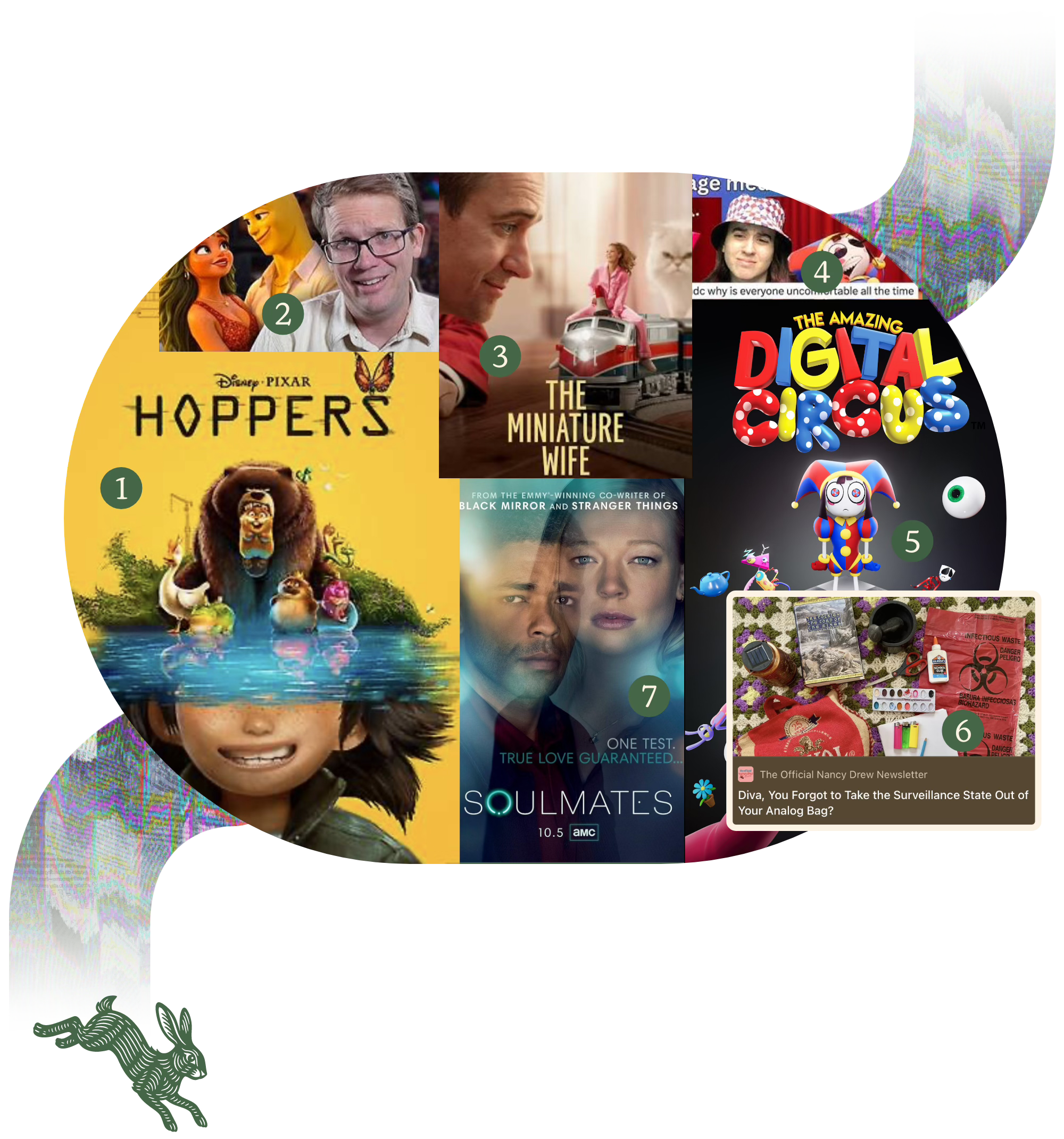
I love me some dystopian/utopian fiction, and the thought exercises it brings up. Last month, I consumed a decent amount of media about the ways in which advancing technology— both in reality and in fiction— impacts how we see and relate to both ourselves and each other. Within the genre’s broader “What would you do?” questions lie some bigger questions about life in the modern era.
The Amazing Digital Circus (TADC) [5], an indie animated series on YouTube created, written, and directed by Gooseworx and produced by Glitch Productions, is inspired by the short story “I Have No Mouth, and I Must Scream” by Harlan Ellison. Both stories indirectly ask the viewer, “What would you do if you found out you’re a digital clone of yourself, and you’re now being tortured by the AI that controls your digital landscape, with seemingly no way to escape?” The original story presents a bleak, visceral answer to the question, whereas TADC seems to (thus far) propose a more optimistic answer in its undercurrent: finding a way forward by discovering and nurturing any humanity that remains, both in yourself and in the other people trapped in this new world. Creation, developing relationships, learning— all ways to pass the time while also finding some fulfillment in this new reality.
The first episode of Soulmates on Netflix (each episode follows a different cast of characters, and I wasn’t super interested in continuing the rest of the series) interrogates free will and fate (or at least, the series’ more scientific version of fate). If there was a way to find out who your “soulmate” is— even if you’re already in a loving, committed relationship— would you want to know? If you don’t choose to find out, would that decision haunt you? If you do choose to find out, what would you do with the information? Is a chosen love better than a love prescribed? What does “better” even mean, in this case? Happier? More fulfilled?
Ultimately, a lot of questions of purpose, of how to go about achieving a fulfilling life. Oftentimes, this relies on agency, and genuine human connection/community. Unfortunately, though, the philosophical quest to lead a fulfilling life ends up butting up against the things that divide us, that delegate some of these fulfilling acts, or make them more artificial. Technological advances can present one of these roadblocks; they simultaneously create opportunities while also generating limitations for their users. The goal then becomes, not only how to lead a fulfilling life, but also how to maintain humanity, a sense of community, and genuine connection in the face of these modern limitations in order to do so.
1 ) 🎬 — Hoppers
2 ) ▶️ — What is “Slop” (and why it gives me hope) — Hank Green
3 ) 📺 — The Miniature Wife
4 ) ▶️ — Intentional loose ends and cringe (critiques about tadc I don’t understand) — Athena PP the memequel
5 ) ▶️ — The Amazing Digital Circus
6 ) 📰 — Diva, You Forgot to Take the Surveillance State Out of Your Analog Bag? — LINDSEY LOUISE, THE OFFICIAL NANCY DREW NEWSLETTER
7 ) 📺 — Soulmates - Episode 1
Make the Thing, Just Do You
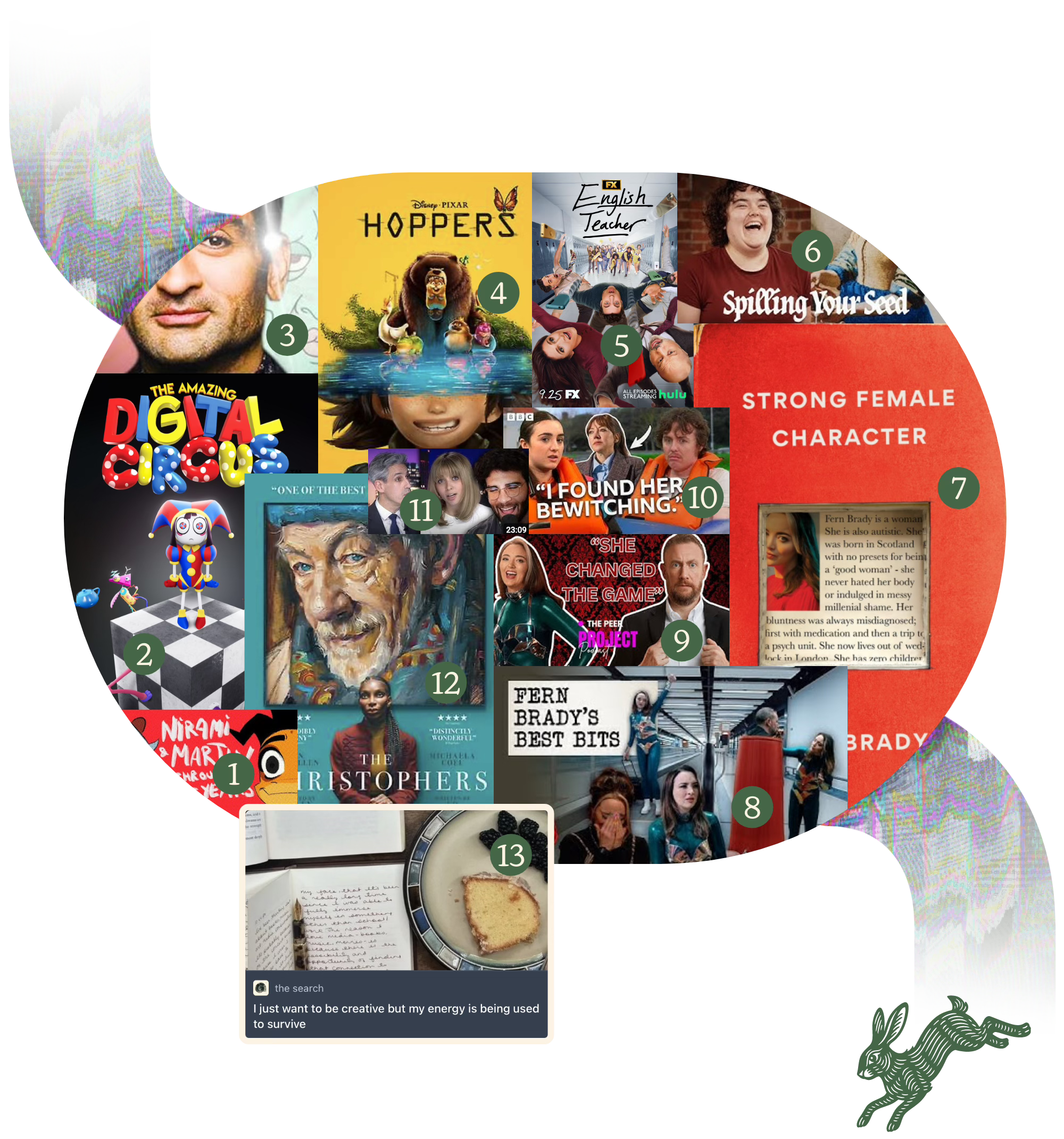
Kind of as an extension of that topic of leading a fulfilling life, I’ve been seeing a lot of things this past month that have been motivational in regards to creating the thing you’ve been wanting to create or being the person you’re destined to be, regardless of what others might think (or, in Kumail Nanjiani’s case, for example, in gleeful spite of what others might think [3]).
Some of these pieces are about creating or becoming, like The Christophers [12], the Kumail video [3] , Fern Brady’s autobiography [7], and the substack article from the search [13].
Others are, in and of themselves, examples of that creating or becoming within their meta— i.e. products of that process—, like Nirami’s animations [1], The Amazing Digital Circus [2], Hoppers [4], English Teacher [5], Spilling Your Seed [6], compilations of/interviews about Fern Brady on Taskmaster [8] [9], Chi’s series with the BBC [10], Kat Abughazaleh’s career journey [11].
Inspiring to see people just create what they imagine, to go for what they want to, to discover themselves, to have the courage they do— in spite of public opinion or any preexisting mental blocks of their own. If there isn't a space, job, or identity that fits them well enough, they create their own. From the outsider’s perspective, any failures to conform to preexisting spaces, are simply instances of character development— further evidence of how necessary it is to create spaces of their own.
1 ) ▶️ — Nirami & Martin through the years! — Nirami
2 ) ▶️ — The Amazing Digital Circus
3 ) ▶️ — Kumail Nanjiani’s Handsome Squidward Paradigm Shift
4 ) 🎬 — Hoppers
5 ) 📺 — English Teacher
6 ) ▶️ — Spilling Your Seed - Chloe Troast
7 ) 📖 — Strong Female Character by Fern Brady
8 ) ▶️ — Fern Brady’s Best Moments | Taskmaster
9 ) ▶️ — Alex Horne Reveals the Taskmaster Contestant Who Changed Everything
10 ) ▶️ — Sam Campbell Wanted To Be Diane Morgan’s Servant on Last One Laughing - BBC
11 ) ▶️ — Kat Abughazaleh COOKED HIM in this debate
12 ) 🎬 — The Christophers
13 ) 📰 — I just want to be creative but my energy is being used to survive — THE.SEARCH
Innovation vs. Imitation: The Price of Selling Out
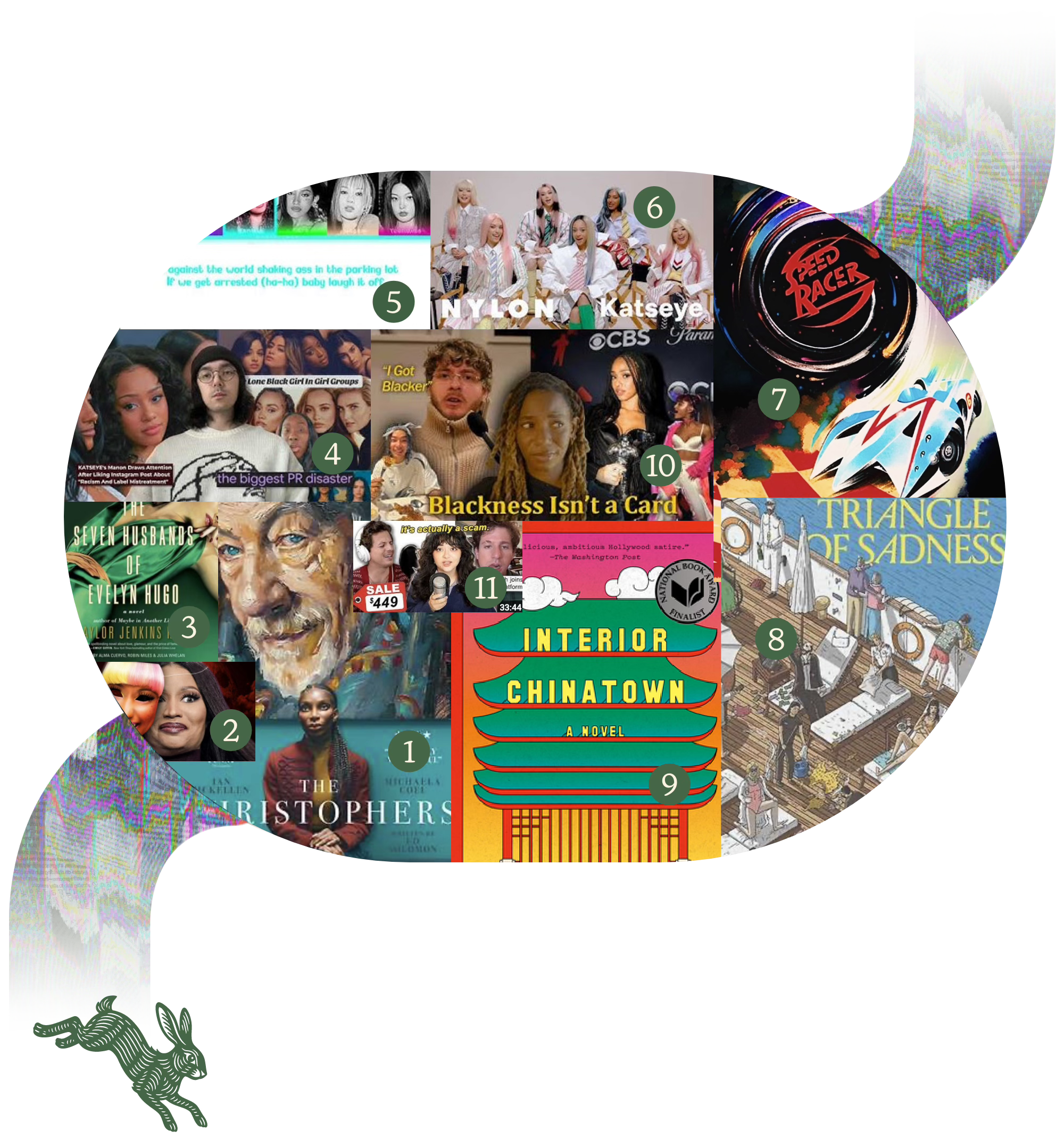
All of that being said, there’s also been a fascinating through-line last month of content that covers the distinctions between innovation and imitation, or more specifically, what it means to “sell out.”
The Christophers [1] follows a woman who is hired to forge/complete a series of unfinished paintings by a famous artist, and as a result, digs into the topic of art as authentic expression vs. the craft of stylistic regurgitation/going through the motions. How it can be seen as cheap, and is often frowned down upon: to not have an artistic voice of one’s own, and to instead seek to impersonate others.
I consumed a lot of content last month about Katseye, too. You can tease the broader conversation that’s taking place into two sub-topics/themes: one about the trajectory of the group’s identity (covering the topics of selling out, having a voice, authenticity) and another about Manon (the member who has been on hiatus, potentially not to return to the group, and the subsequent topics of the treatment of black women in these spaces, and potential reasons for the split).
There’s something about the newest song and music video, the direction the group has taken, that just strikes me as so… cynical? Like the Powers That Be™ are chasing an algorithm, older men in suits trying vaguely to appeal to a younger, largely female audience. Gnarly was as effective as it was because it was a different direction that felt more authentic to the girls. It was risky, fun, and shook things up, and the choreography sealed its virality. The members were excited and involved in the concept, with obvious hesitation mixed in because of how far of a jump it was from their SIS era. Gabriela came next, and felt like confirmation of an exciting new era for the group, one marked by genre experimentation, honoring the different cultures and languages in the group, and showcasing their vocals. Since then, we’ve seen attempt after attempt to manufacture Gnarly’s lightning in a bottle, with songs like Internet Girl and Pinky Up; increased use of advertisements as art; and a dual trend of decreasing clothing and increasing sexualization, especially after Yoonchae, the youngest member, turned 18. There’s another conversation to be had here, about female empowerment and internalized misogyny, but I also feel like the sexualization reads more as a function of the larger corporate machine and the male gaze, than it reads as an authentic expression of sexuality. Katseye is a global girl group, but is run with a Kpop mentality. In what ways is it held back by its Kpop roots, by the entertainment machine at large? Are they being sabotaged intentionally for straying too far from the norm?
Interior Chinatown by Charles Yu centers a character that often exists in the literal margins of stories: The Asian Man. Constantly relegated to stereotyped roles, Yu’s protagonist, Willis, fights against his constraints, both external and internal. Being told you can’t do something time and again is something that will grow roots in you, regardless of whether you want otherwise or logically know it isn’t true. Dismantling your own internalized limitations and cultural biases is hard work, but necessary if you want to have any hope of breaking free. Easier said than done, but still— something to learn from, to use as a lens to examine one’s own life, the things at play in one’s own subconscious.
Just because something is easy, or has always been done this way, should it continue/should you follow suit?
1 ) 🎬 — The Christophers
2 ) ▶️ — From Rap Icon to Self Sabotage? | Nicki Minaj’s Story
3 ) 📖 — The Seven Husbands of Evelyn Hugo by Taylor Jenkins Reid
4 ) ▶️ — Katseye: How to exploit young women
5 ) ▶️ — [AI REMAKE] KATSEYE (캣아이) ‘Pinky Up’ (Color Coded Lyrics) | rubyeyekon
6 ) ▶️ — Katseye Test Their Pop Culture Knowledge In NYLON’s No Phone Zone
7 ) 🎬 — Speed Racer
8 ) 🎬 — Triangle of Sadness
9 ) 📖 — Interior Chinatown by Charles Yu
10 ) ▶️ — Why do we Keep Rewarding Cultural Appropriation?
11 ) ▶️ — I took Charlie Puth’s AI music class so you don’t have to
Tension between Authentic Expression & Cultural Bias
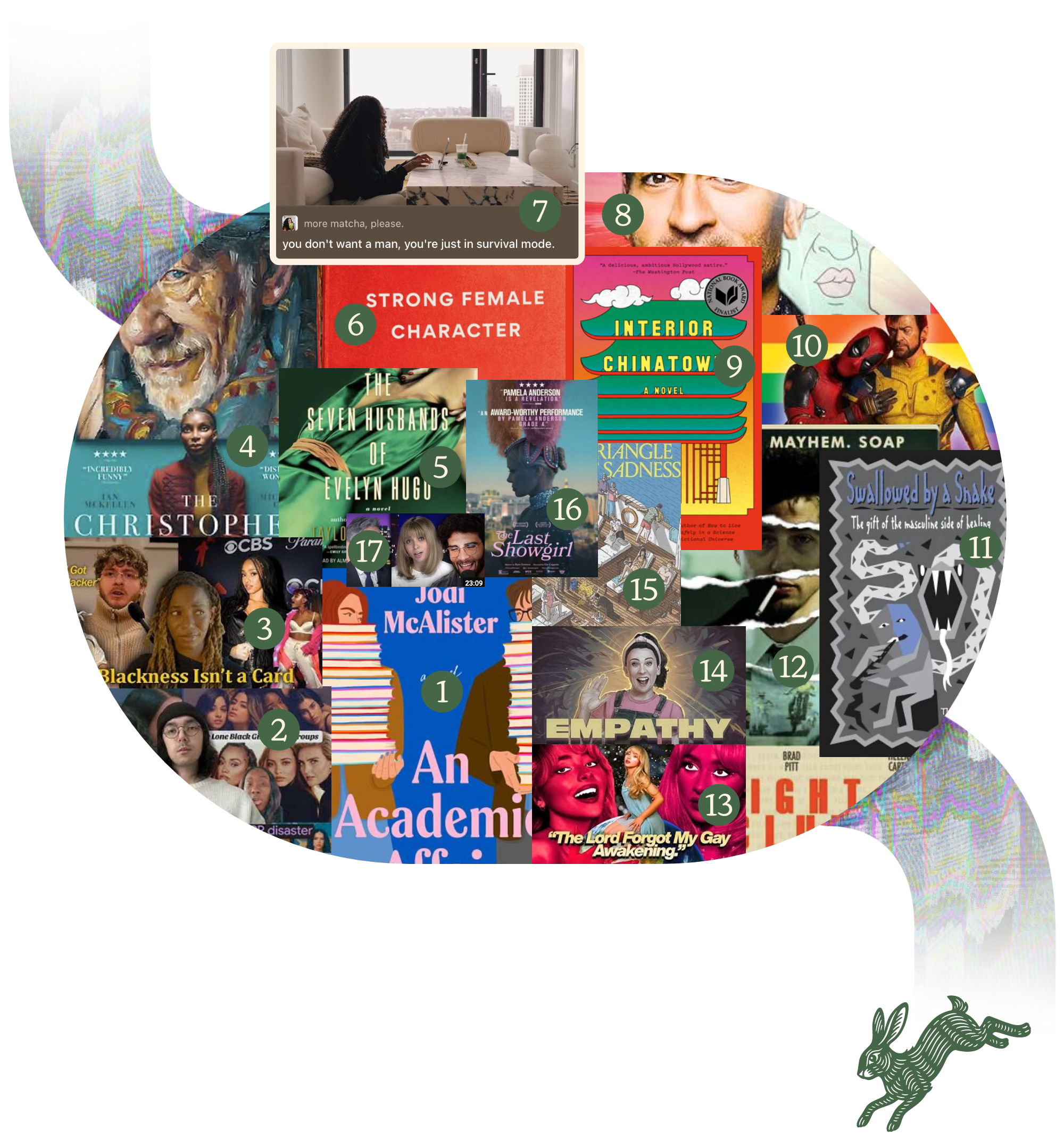
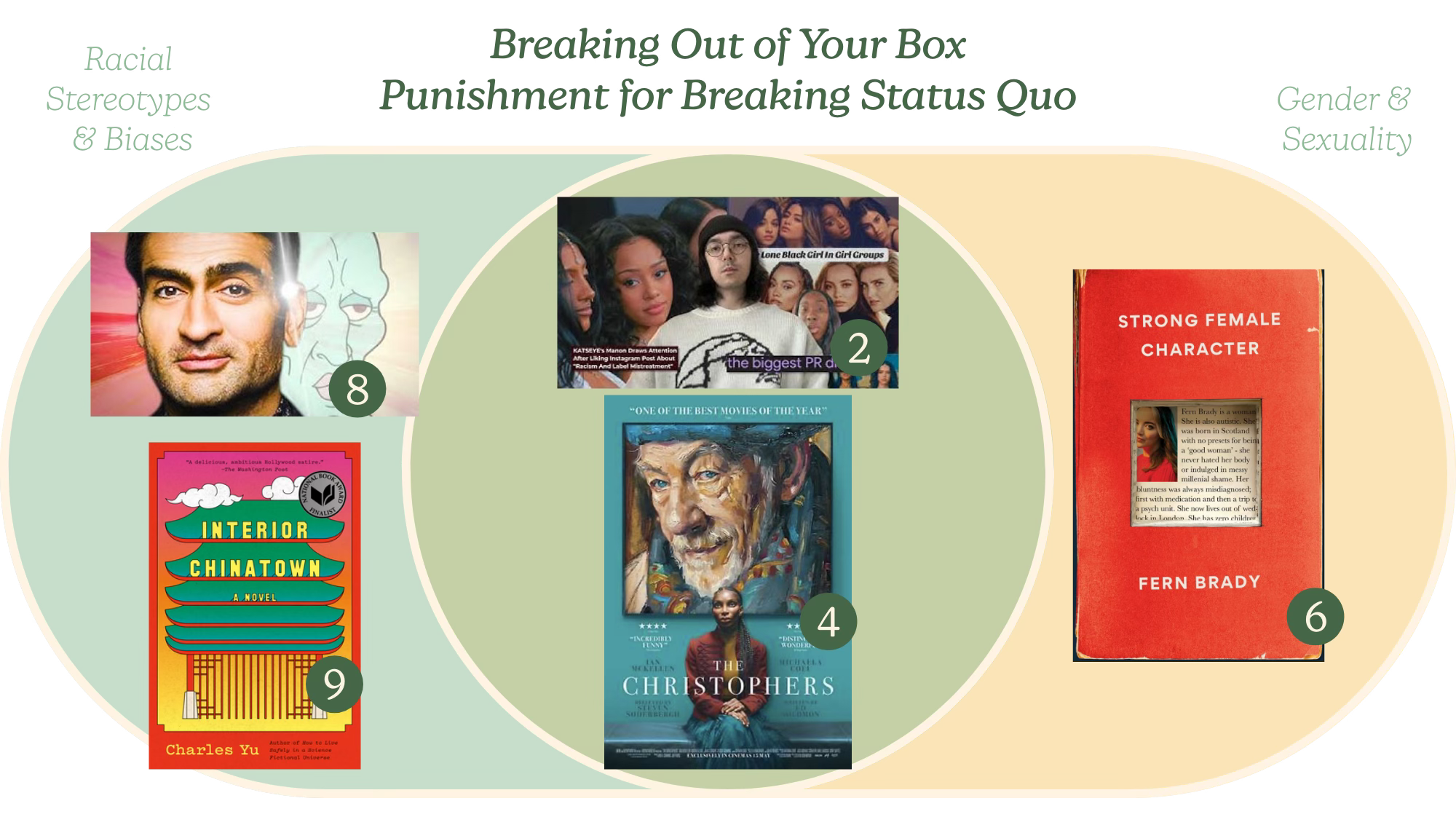
There’s a lot of overlap between the previous topic and this one. I’m going to include some Venn diagrams here, and maybe I’ll revisit this piece to write my thoughts out a bit more later:
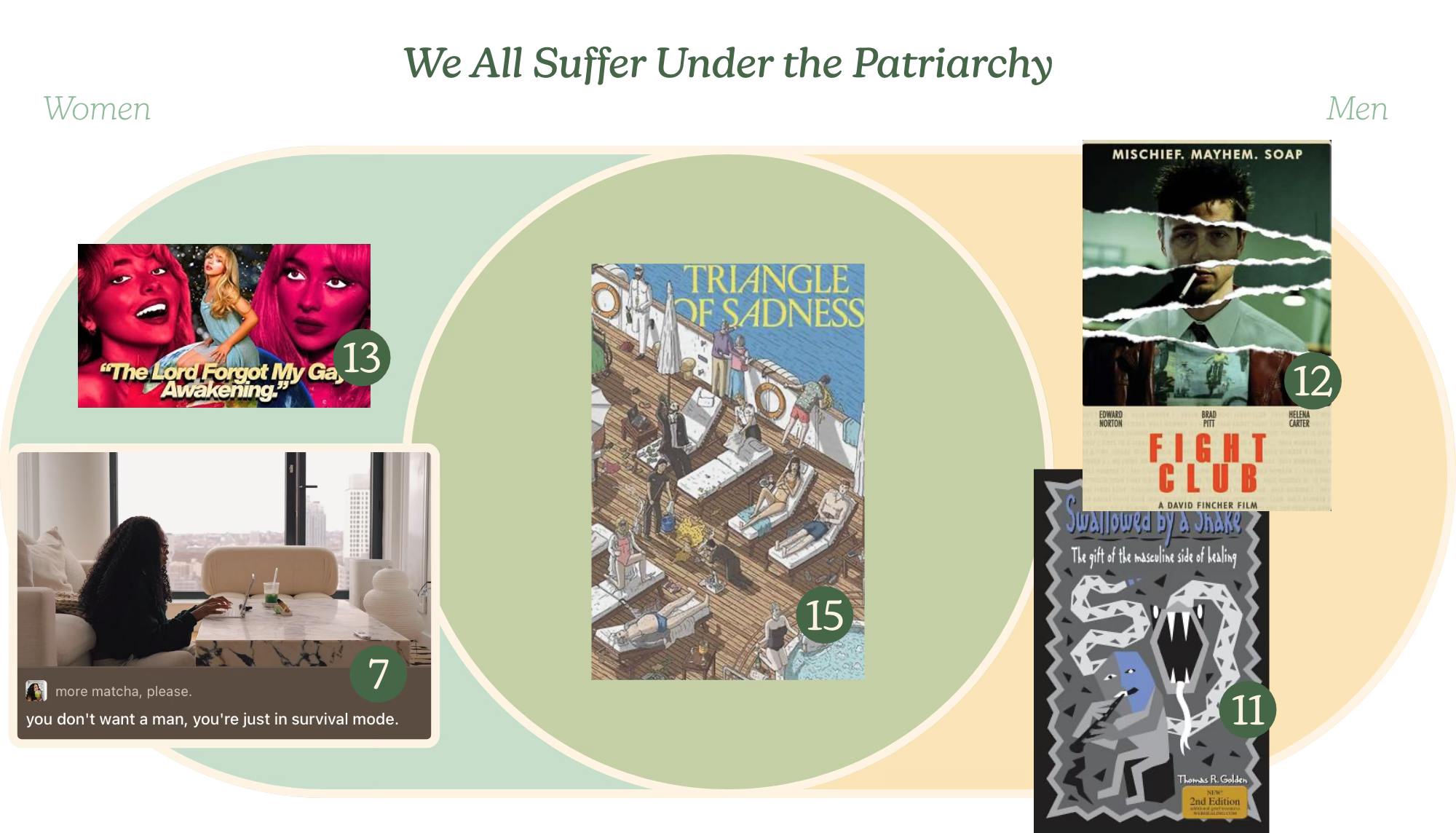
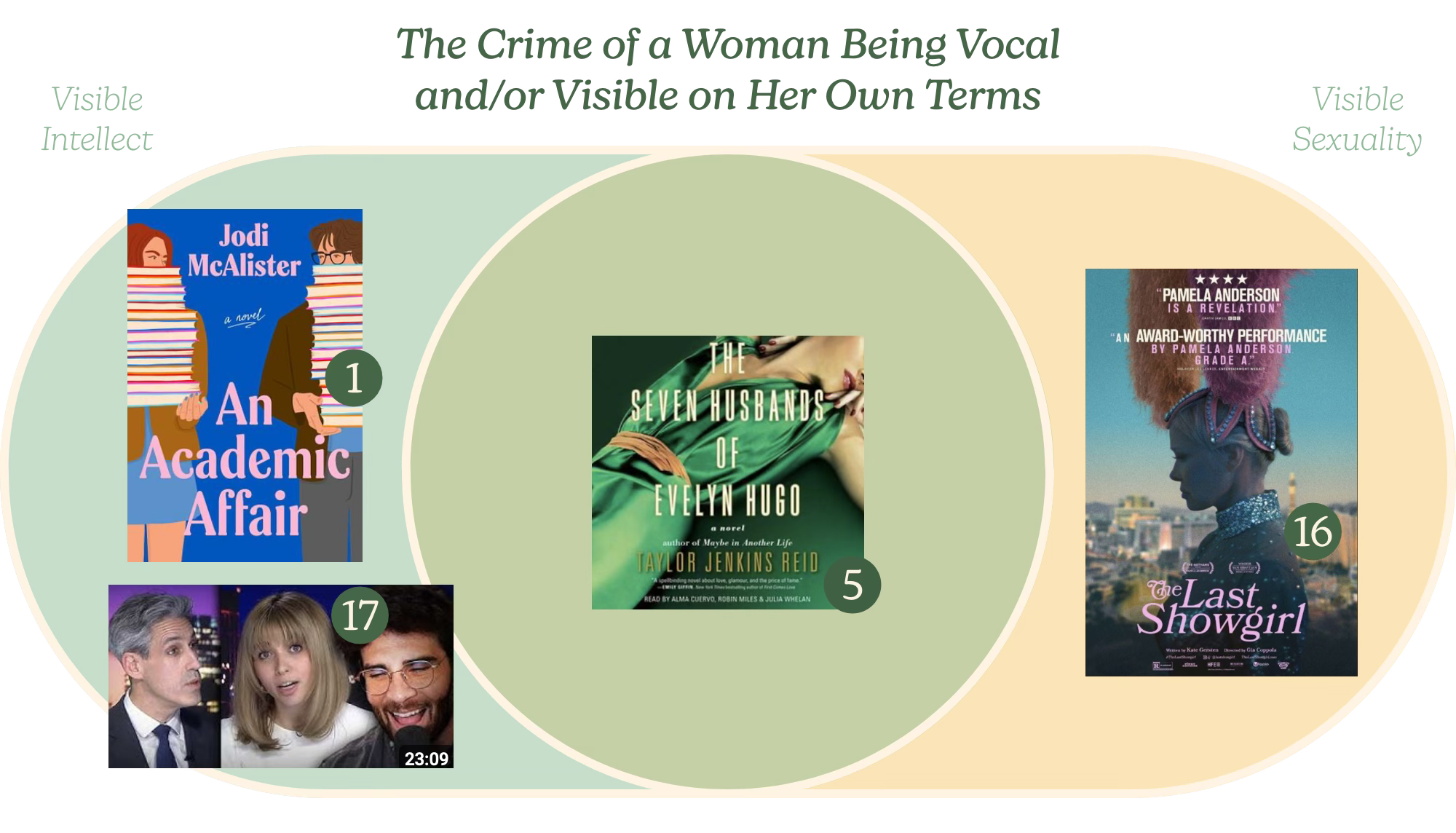
1 ) 📖 — An Academic Affair by Jodi McAlister
2 ) ▶️ — Katseye: How to exploit young women
3 ) ▶️ — Why do we Keep Rewarding Cultural Appropriation?
4 ) 🎬 — The Christophers
5 ) 📖 — The Seven Husbands of Evelyn Hugo by Taylor Jenkins Reid
6 ) 📖 — Strong Female Character by Fern Brady
7 ) 📰 — you don’t want a man, you’re just in survival mode. — AMANI RAKEIA, MORE MATCHA, PLEASE.
8 ) ▶️ — Kumail Nanjiani’s Handsome Squidward Paradigm Shift
9 ) 📖 — Interior Chinatown by Charles Yu
10 ) ▶️ — Are the Deadpool Movies Homophobic? — orowen
11 ) 📖 — Swallowed by a Snake: The Gift of the Masculine Side of Healing by Thomas R. Golden
12 ) 🎬 — Fight Club
13 ) ▶️ — Sabrina Carpenter’s Glamorous World of Hetero-Pessimism
14 ) ▶️ — The Unforgivable Sin of Ms Rachel — Lindsay Ellis
15 ) 🎬 — Triangle of Sadness
16 ) 🎬 — The Last Showgirl
Power Dynamics, Personalities, & Hierarchy
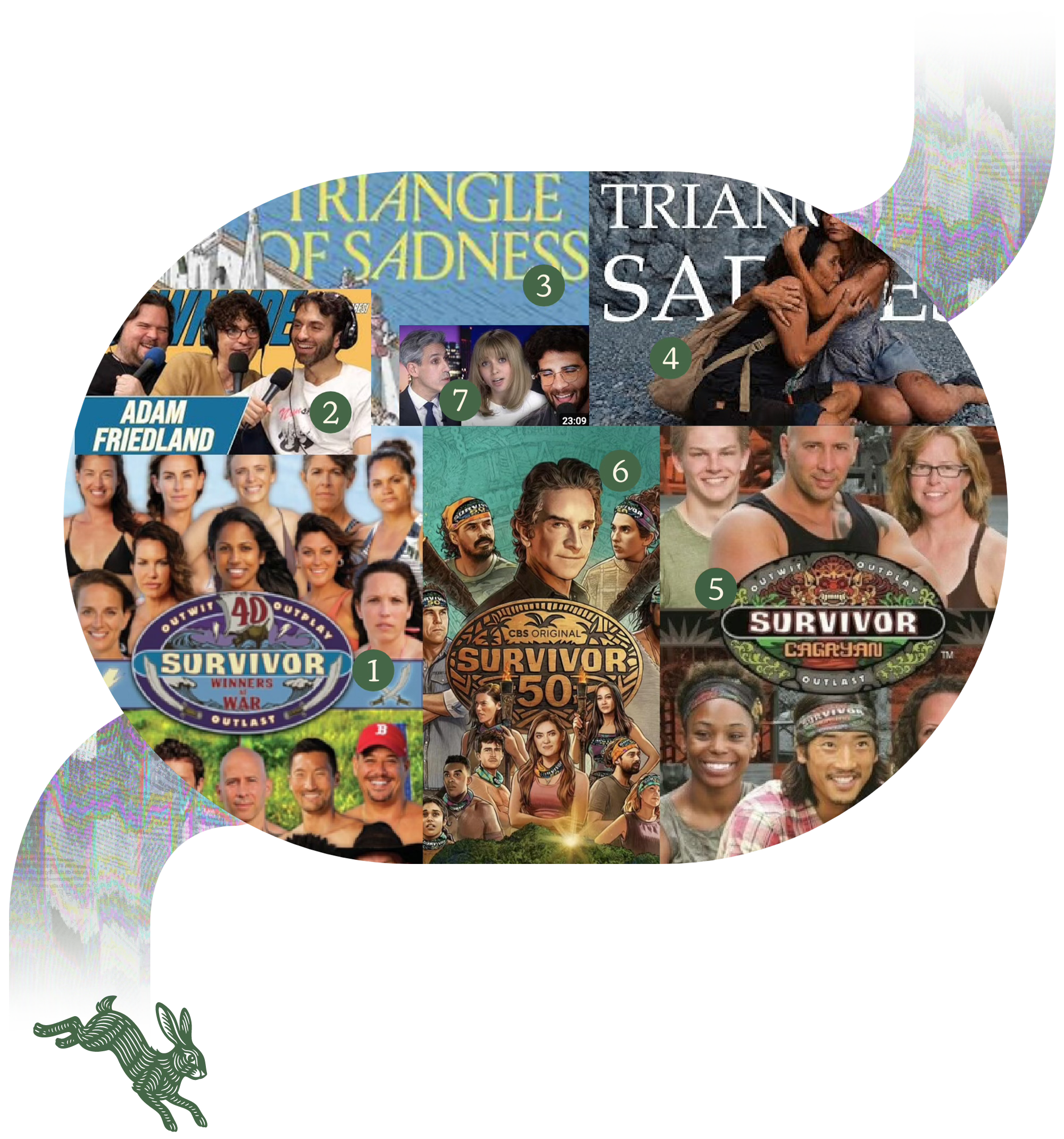
One of my favorite things about Survivor [1] [5] [6] is seeing the social game at play, observing how people organize themselves into hierarchy and alliances. It’s fascinating to see the lengths players will go to in order to move the game in their direction while also maintaining likability or flying under the radar enough to make it to the end. We see similar dynamics in Triangle of Sadness [3], too, but I don’t want to spoil it for anyone who hasn’t seen it. The ways in which we signal to each other our places in the hierarchy is so old-world and also… monarchic? You see this pattern often enough in Survivor: the King/Queen dynamic. Watching the strategists on Survivor calls to mind a bunch of things, like Game of Thrones (specifically Varys’s character), chess games, monarchies of old, the creation and deconstruction of hierarchy and government in Red Rising, childhood games of Red Light/Green Light, and more. You want to play the middle, appeal to both sides, but also don’t want to be caught doing it. You want to pull the strings in a way that isn’t too visible or obtrusive to the other players during the game, while also recognizable enough to provide evidence for why you deserve to win at the final tribal.
1 ) 📺 — Survivor Season 40
2 ) ▶️ — Favorite Woody Allen Movies with Adam Friedland
3 ) 🎬 — Triangle of Sadness
4 ) ▶️ — Ending Explained & Character Analysis - Triangle of Sadness
5 ) 📺 — Survivor Season 28
6 ) 📺 — Survivor Season 50
7 ) ▶️ — Kat Abughazaleh COOKED HIM in this debate
The Duality of Grief & Eucatastrophe
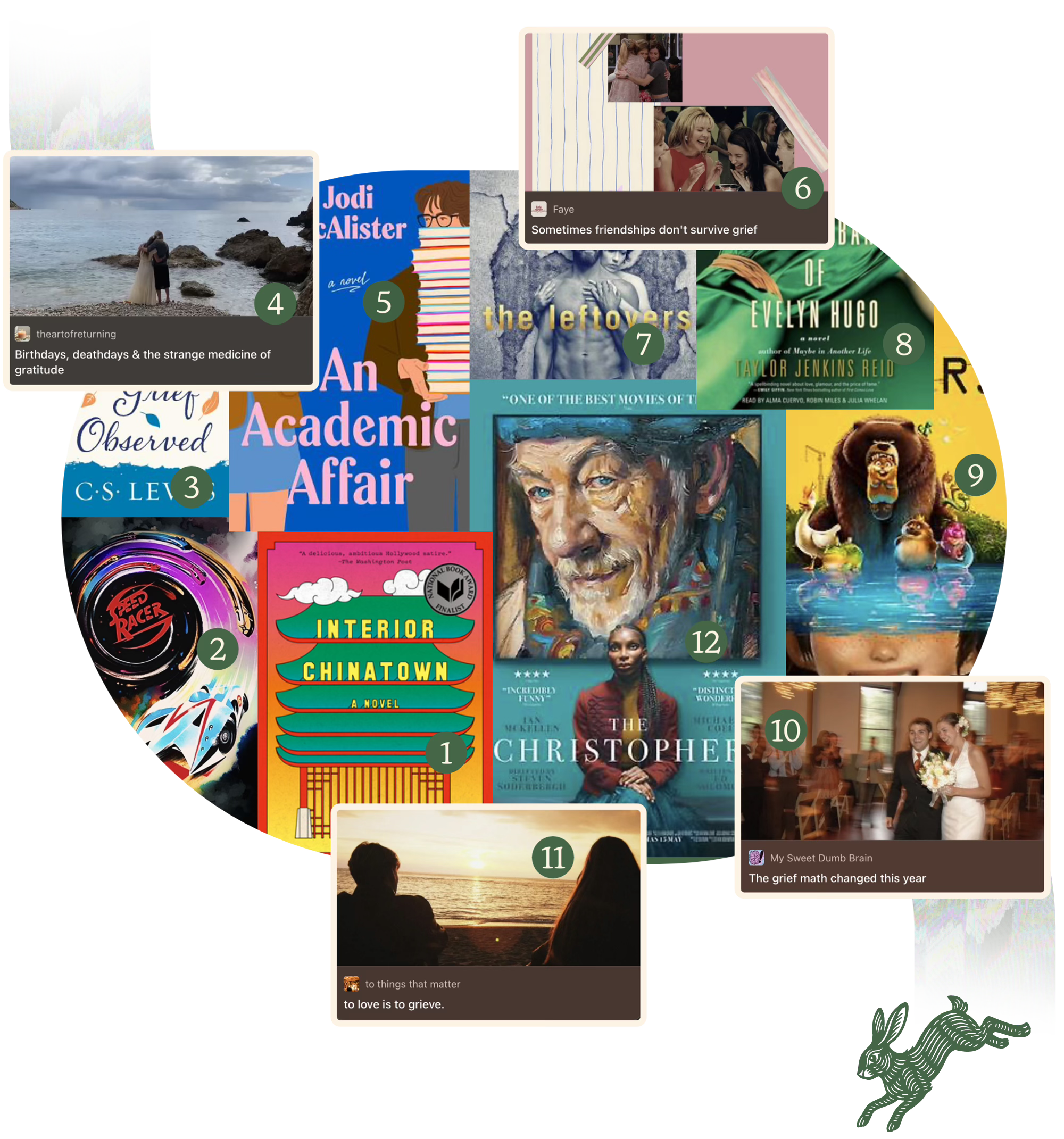
“Eucatastrophe is joy poignant as grief. The joy cannot be truly felt in a world where grief isn't possible.” — An Academic Affair by Jodi McAlister
The anniversary of my dad’s passing was at the middle of the month, and March and the beginning of April was characterized by a lot of escapism. Fascinating how, even though grief was front and center in my mind throughout that month, it wasn’t in a lot of the content I was consuming— likely by design.
1 ) 📖 — Interior Chinatown by Charles Yu
2 ) 🎬 — Speed Racer
3 ) 📖 — A Grief Observed by C.S. Lewis
4 ) 📰 — Birthdays, deathdays & the strange medicine of gratitude — THEARTOFRETURNING
5 ) 📖 — An Academic Affair by Jodi McAlister
6 ) 📰 — Sometimes friendships don't survive grief — FAYE
7 ) 📺 — The Leftovers
8 ) 📖 — The Seven Husbands of Evelyn Hugo by Taylor Jenkins Reid
9 ) 🎬 — Hoppers
10 ) 📰 — The grief math changed this year — KATIE HAWKINS-GAAR, MY SWEET DUMB BRAIN
11 ) 📰 — to love is to grieve. — TO THINGS THAT MATTER
12 ) 🎬 — The Christophers
The Postscript
Noticed there are lots of video essays and podcast episodes— I like listening to them while working, doing a puzzle, cooking, etc. That said, it’s good to go back through them and separate the ones that really stuck out to me, while also noticing the history of things I watched/listened to, without remembering much of anything from them. (I didn’t include any of those in the rabbit hole, though, because I wanted to pay more attention to things that seem to have consciously made an impact). So crazy to see it all in black and white, how much much noise there is in general, but also how much I invite into my life, into my brain.
This exercise in examining the media I consumed during the month was heavily inspired by sihaam’s spiral series on Web Weaving 🌀— highly, highly recommend: