


I’ve reworked this intro multiple times, never quite feeling satisfied with it, but not fully knowing why. I think there’s a level of self consciousness at play, a fear of seeming like I have more of a grasp on (or control over) grief than I do. That seeking to understand someone else’s process communicates a level of already having “mastered” my own. As though I view grief that’s different from my own much like an exotic animal at the zoo, complete with ogling at and tapping on the glass of its enclosure. Lots of overthinking going on over here... Can you tell that one of the bigger side-effects of my grief lately has been insecurity?
I struggled with the framing of this article, with ironing out its precise purpose. I feel like it will be useful for me to revisit this post, to have this as a helpful refresher with most of the key quotes and findings in one location to reference. I’d like it to be useful for other people, too, but I wonder how much of myself and my experience with grief is the right amount to include— how much is helpful vs. how much distracts from the reader’s goal (whatever that might be). Should this be more of a book report/summary/review, an academic article, or a journal entry/memoir? I wasn’t quite sure, so the result ended up landing somewhere in the middle.
My siblings, mom, and I all grieve differently, and, as a result, our processes will sometimes bump up against each other. I was curious about my brother’s in particular, because, from the outside looking in, it almost felt like our processes were inverses of one another. Granted, both were neutral— i.e. one wasn’t the “right way to grieve” with the other being “the wrong way to grieve”— but they seemed to move in opposite directions. How does one know what’s normal for another’s process vs. what should be “concerning”? From different grief groups and sources, I had come to understand that the grieving process tends to look different for men, but I was curious and sought to understand it better. So, without further ado, I started researching.

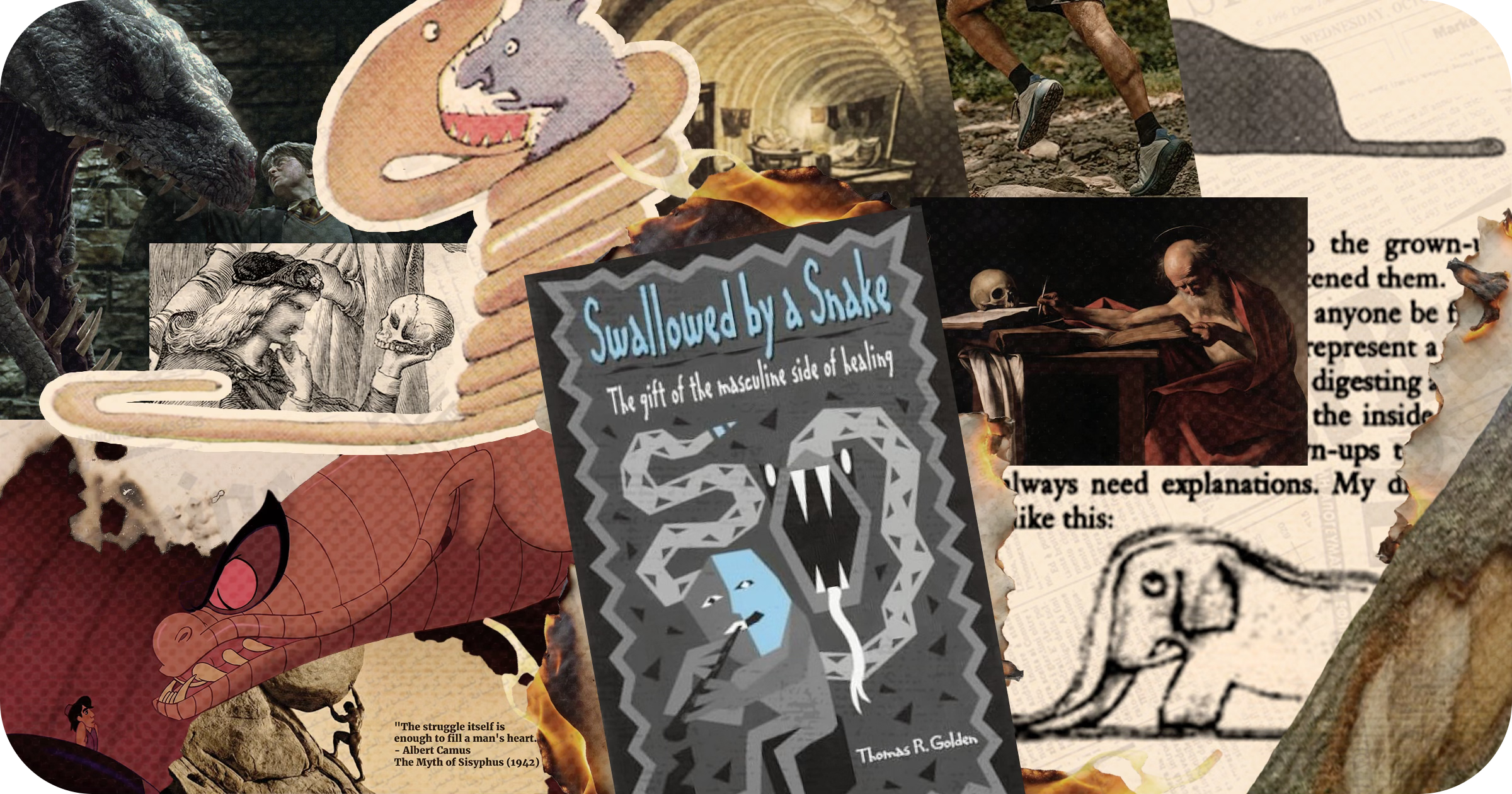
Flash forward to me reading “Swallowed by a Snake: The Gift of the Masculine Side of Healing” by Thomas R. Golden, LCSW. I really found this book at the right time in my own grief journey, when I was beginning to earnestly seek ways to be less at the whim of my grief cycle/pattern, and instead try to make a more intentional effort to incorporate grief into my day-to-day life, to engage its release valve and tap into the feelings more often, if possible. It felt like it would be kinder to myself. I didn’t realize that what I was yearning for was, as Golden puts it, ritual.
This book feels like such a kindness to male and female audiences alike. Golden provides his readers with “a map of the terrain” (which also happens to be the first on his list of “What aids the masculine?” in the book), and outlines the process of grief and the ways in which people tend to approach it, with steps and variables, as well as metaphors and real-life examples. He takes the subjective, amorphous, immense, seemingly taboo, and not-spoken-about-enough topic of grief and makes it a little more tangible. It’s so generous, to provide a griever with some feeling of relief and stability within something that often feels like it doesn’t even have a foothold. But Golden manages to do all of this while still taking care not to venture into oversimplification or downplaying the emotional work involved. He makes it clear to the reader that grief is not a pathology or something to be solved or quickly “gotten over”— an important thing to point out when the cultural impulse can be to speed-run things and check off boxes.
I loved the ways that this book touched upon biology, sociology, communication styles, shadow work, attachment styles, and more. Golden counter-weighs his claims time and again with the point that, though there are larger grieving patterns that tend to differ between the genders, the grief process is still an individually unique one that blends methods, and isn’t strictly black or white.
“Women use masculine modes of healing just as men use the feminine. The important thing is finding our unique balance of masculine and feminine energies and honoring our own path.”
— “Swallowed by a Snake: The Gift of the Masculine Side of Healing” by Thomas R. Golden, Pg 129
So much of what we think we know is based on biased sample sets, or mistakenly applying circumstance-specific findings too broadly, playing fast and loose and painting with too wide an academic brush. A few examples: Kübler-Ross outlined The Five Stages of Grief as a pattern that emerges specifically for people receiving a terminal diagnosis, but the broader culture has taken it and tried to apply it as a step-by-step guide to grief as a whole. According to Golden, the “Fight or Flight” response is based on a biased pool, largely men. He also informs us that most of our view of therapy is also based on a biased pool of primarily women, which raises some interesting questions.
When we take information that’s the “function of a biased sample”1 as universal truth, we of course leave out the minority— or less-represented— group in that sphere. As a result, we end up less informed and harm, not only the underrepresented group, but also ourselves as an entire collective. Acknowledging these misconceptions and gaps in knowledge is the first step, followed by seeking to re-educate ourselves. Thankfully, reading this book felt like a step in the right direction.
So, it’s all kind of a mess, but… we’re getting there? Hopefully?
In his book, Golden encourages a widening of the scope, and, by extension, a little more understanding of and empathy toward different communication styles and grief processes. While reading “Swallowed by a Snake: The Gift of the Masculine Side of Healing,” I, as intended, began to understand my brother’s process a little more. But what surprised me while reading was how much it reminded me of and brought clarity to my perception of my father’s grieving process with his dad, and also how the book helped me better understand different facets and evolutions of my own shifting grief process. Widening the scope, indeed.
“Swallowed by a Snake”
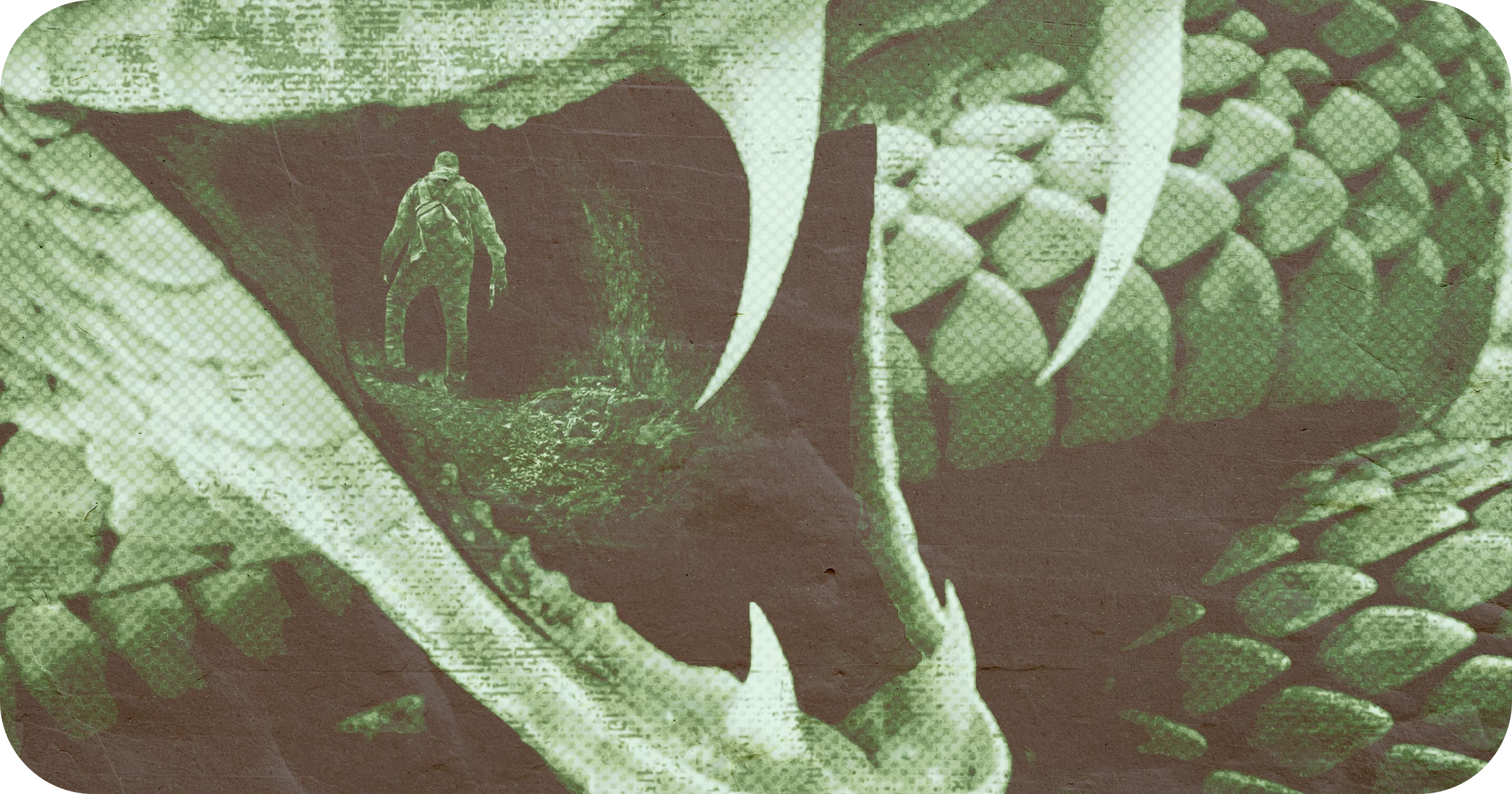
Let’s begin with the titular story: Once upon a time, a giant boa constrictor was terrorizing a village. The village’s local flute player went out into the woods, playing his flute to summon the snake. The boa swallowed him whole, and, within the belly of the snake, the flute player had to learn to exist there and was faced with the challenge of learning to methodically work his way out.
Flute-Playing to Summon Your Boa
The man in the story plays his flute to get into the snake - oftentimes, people will use their strengths, creative or otherwise, to access their grief in safe ways.
“With our void of socially-endorsed grieving rituals, men have had to be creative in finding active ways to lead them into their boa. Many times the activities that men find, like our protagonist’s flute playing, will be related to their psychological strengths. Finding and using this strength as a means to enter into grief is a vital exercise for men.”
— “Swallowed by a Snake: The Gift of the Masculine Side of Healing” by Thomas R. Golden
Some of you might be asking, “But why would I even need to ‘summon’ it? My grief is always present, always in the back of my mind, or weighing on me, mentally and physically.” You’d know best how you’re feeling in your brain and body, so take inventory and proceed however feels right. Perhaps you’re already in the belly of the snake; in my experience, in early grief or around certain milestones, depending on your grieving style, it can be easy to stumble into the boa without even needing to pick up your flute.
But also, you could be feeling the impact of untended grief. I can definitely relate to this, experiencing the impact of that grief constantly, and feeling like that surely must already be doing some of the work. The key here, though, is shifting the mindset, of proactively and intentionally interacting with your grief, of facing it head-on. As opposed to letting your grief act on you, you can act on it. (If you’d like, you could click here to skip ahead to the next section and find out more about rituals.)
Existing in the Belly of the Beast
Now that you’re in the belly of the snake, and are in direct contact with the grief, the work begins. Not necessarily the mechanics of the ritual you chose to access the grief, but rather the process of actually dealing with the snake, with the grief. Unpacking, holding space, feeling and expressing your feelings, etc.
“Notice that the flute player did not continue playing once he was in the belly; he had to use other skills in order to deal with the snake. Also notice that his work was not done from the outside, but was accomplished from inside the snake. This is the way it is with grief. We must do this work from the inside, but find our way into it through our strengths.”
— “Swallowed by a Snake: The Gift of the Masculine Side of Healing” by Thomas R. Golden
Things are different in the belly of the snake, whilst looking your grief in the eye. Your body and brain are impacted and operate differently than they normally do.
“We are cut off from our everyday life, we feel that our existence is confined, and we are surrounded by our grief like the flute player was. Our world is completely changed, going from life as we know it into the belly of a snake. Imagine being in the belly of a huge snake. Dark. A very tight spot. Every place you turn, there is the belly of the snake. The entire environment is this wet, warm, restrictive belly, pulling at you to conform to its wishes. This is similar to the way a person may feel who is experiencing a deep grief. Sometimes the grief takes over, and you feel that your life has to conform to the grief rather than to your own wishes.”
— “Swallowed by a Snake: The Gift of the Masculine Side of Healing” by Thomas R. Golden
“I’ve seen dark before
But not like this
This is cold
This is empty
This is numb
The life I knew is over
The lights are out
Hello, darkness
I’m ready to succumb”[…]
“This grief has a gravity
It pulls me down”— The Next Right Thing, Frozen 2
The skills and toolkit that normally serve you are not necessarily useful here. All of the rules are different now, and learning the terrain is vital.
“When in the belly, we must learn a different way of living. In this dark, restrictive environment our usual skills for living are not particularly effective. The situation calls on us to use parts of ourselves that are not our usual strengths. Instead of seeing clearly what is before us, we might have to grope around, using our sense of touch rather than our eyes. Once our activity has brought us into the belly, we may need to find or develop other skills that will help us in navigating this inner terrain.”
— “Swallowed by a Snake: The Gift of the Masculine Side of Healing” by Thomas R. Golden
“When I say that grief is a kind of learning, I don’t mean learning something easy. This is not like mastering a specific skill such as riding a bike, learning how to keep our balance and how to use the brakes. This type of learning is like traveling to an alien planet and learning that the air cannot be breathed, and therefore you need to remember to wear oxygen all the time. Or that the day has thirty-two hours, even though your body continues operating as though it has twenty-four. Grief changes the rules of the game, rules that you thought you knew and had been using until this point.”
― Mary-Frances O’Connor, The Grieving Brain: The Surprising Science of How We Learn from Love and Loss
You’re tempted to think you are one with the snake, that there is no way out. But that’s exactly what the snake wants you to think. That is how the snake wins.
Carving Your Way Out
The true way to survive being swallowed by a snake is to carve away at it, piece by piece. Every time you intentionally access your grief and allow it to hold space, you are carving away at the belly of the snake, and slowly but surely getting closer to daylight.
“I won't look too far ahead
It's too much for me to take
But break it down to this next breath
This next step
This next choice is one that I can make”— The Next Right Thing, Frozen 2
A Process that Demands Ritual

Instrumental (often associated with “Masculine”) Grieving
The process of linking one’s grief to an action, place, or thing.
Creativity — (creating something yourself, or consuming things others have created)
Practicality — (doing things in honor of the loss- dedications, memorials, imbuing with meaning, using special interests of the person who died, gardening, running)
Mentality — (i.e. thinking - meditation, letter writing, active imagination)
If you are an instrumental griever, it can be helpful to link your grief to an action, place, or thing via ritual in order to further tap into it.
“Ritual is a way for us to consciously take a small sample of our chaos, our grief, and to process that sample in our own time. By doing this, we get to know our grief and our chaos a little bit at a time.”
— “Swallowed by a Snake: The Gift of the Masculine Side of Healing” by Thomas R. Golden
What do these rituals look like? Annoying answer, but it differs person to person. Rituals tend to be characterized by one or more of the following: Creativity, Practicality, and Mentality. Some rough examples to give you the gist, but by no means encompass everything: Creativity Rituals can look like painting, listening to music, or watching a movie. Practicality Rituals can look like visiting the cemetery, dedicating something in memorial, gardening, or going for a run. Mentality Rituals can look like meditation, journaling, or writing a letter to your loved one.
Overall, “people will tend to practice rituals that align with their strength in order to make contact with their chaos in a safe way.”2 Generally speaking, men and women tend to find safety in very different places, with women seeking support through relationships with others, and men seeking a more private and action-oriented container for their grief ritual. That being said, it’s important to reiterate that each person’s process is individual— just because one form of grieving comes more naturally to you at one point, doesn’t mean the other form isn’t or won’t be valuable to you as well. With the way our processes can ebb, flow, and evolve, there’s always the potential for your secondary mode of grieving to become your primary, for there to be change within how you grieve.
So, anything can be a ritual, right? Sure, but, again, the crucial bit is the intentionality behind whichever ritual you choose— by mentally tying it back to the grief and the person lost, engaging in an action or interacting with a thing allows you to access the grief via external aids:
“In grief rituals, unlike our previously mentioned habits, we are practicing behaviors that consciously and intentionally move us out of our ordinary awareness and into the experience of the pain of grief.”
— “Swallowed by a Snake: The Gift of the Masculine Side of Healing” by Thomas R. Golden
I’ve found it interesting to talk to my family members in the wake of our loss/in the midst of our varying processes, and have noticed that we sometimes end up talking about the same things, just in different dialects. Because we have varying ways of learning and thinking about things, we end up with different words to describe similar experiences within our grief. Reading books like this one can deliver a similar feeling, one of excitement, validation, and fascination.
Over the course of the past year, I’ve found certain places to feel like they hold intangible doors through which I can access my grief. Each door is unique, allowing me to view the grief from a different angle, seeing into its different facets and depths. When I began reading Crying in H Mart by Michelle Zauner, and saw how strongly Zauner felt her mother’s presence there, I began to consider what those places might look like for me, places that help me feel my dad’s presence, where I could be strongly reminded of him. Visiting the cemetery, going to the car magazine section of our local Barnes & Noble, and taking a trip to upstate NY to see an art exhibit for Calvin and Hobbes, each brought up unique emotions and memories. For example, peeking my head into that intangible grief door at the Calvin and Hobbes exhibit allowed me to hear my dad’s voice and intonations as he’d read the comics to me as a kid, and brought countless memories to the foreground, including the jokes and panels he found especially funny. Interesting how much the nature of these charged places can vary as well, with some locations being directly related to my dad’s passing and funeral, some locations being the set of specific memories with him, and other locations signifying the future with him in mind— things he would have enjoyed, things he never got to see but I know he’d have loved to, etc. To go a step further, isn’t it fascinating how certain locations linked to the past can bring up sobering thoughts about the “future that could have been,” while locations linked to the future can bring up vivid memories of the past?
Meanwhile, certain items have functioned as talismans (or powerful keys, if we’re sticking with the door metaphor) that can summon these doorways to grief anywhere. My family started a Memory Lane binder and Google Forms questionnaire that allows people to write things about my dad, memories they had with him, about the person he was, about how he touched people’s lives. It’s such a beautiful and valuable way of remembering who he was, how others saw him, and a perfect aid to tap into the grief, wherever we are.
When active, instrumental grieving is your primary mode of grieving, though, our culture isn’t very kind to you. As Golden describes, people with differing processes can be suspicious of or concerned about each other, often manifesting in men thinking women are “overdoing it,” and women thinking men “aren’t grieving at all.”3 While many women, in theory, have resources at their disposal like therapy, grief groups, and conversations with friends that align with their approach to grieving, most grieving men are at more of a cultural disadvantage:
“One of the reasons that men tend to have an easier time in connecting their grief with action is that men have a harder time in connecting their emotions with words. […] This preference for action puts men in a precarious state when grief strikes because in our culture almost all of the activities related to death have been contracted out.”
“Eulogies are one of the last remnants of active grief rituals in our culture.”
“It was my experience, and that of other men I have known who have given eulogies, that it was an important event in our lives. The memory of speaking, or sometimes writing, carries on through the cycle of grief and becomes a marker for the experience. By remembering the act of speaking, we connect with the feelings that were present at the time and those that continue. Somehow it is easier to remember the act of speaking and the associated feelings than to simply “remember” how one felt. It is easier to talk about the eulogy you gave than simply talking about the feelings. The act becomes a hook for the expression of emotion, even as the grief continues.”
— “Swallowed by a Snake: The Gift of the Masculine Side of Healing” by Thomas R. Golden, Pg 136-137 ; Pg 143; Pg 143-144

My dad died in the week leading up to Easter, and, according to Catholic tradition, funerals aren’t held until after the holiday. Among other things, this meant we had a little extra time for preparations, and so my family and I designed custom funeral cards and put a lot of effort into making the space for his wake really communicate the person he was. People who hadn’t met my dad came up to us after going around the rooms to tell us they felt that, through looking at all the things we had put out, they really got to know him. Nothing felt “good” at the time, but this? This, at least, felt right. It’s what he deserved.
We each spoke at my dad’s funeral, with individual eulogies. I’m grateful we did, because each one was different enough, that it felt like we each played a part in shading in different aspects of a portrait of my dad for the congregation. We included those eulogies in our Memory Binder alongside people’s submissions.
All of this to say, I don't know how much of this truly felt like ritual to really process the grief in the moment— so much of the early grief, especially the days leading up to the services, was characterized by heavy fog and an intent on just surviving/enduring, even with our ears still ringing from the bomb that had gone off in our lives. However, Golden is right: these rituals really do function as a marker for that time— the feelings, the experience. It also helps to have the physical copies of the eulogies in the binder, to have photos and video of the setup for the wake, etc. Those things become a ritual in and of themselves, a talisman/key to access the grief.
I just want to note some things this brought up, memory-wise, for me about my dad’s grieving process for his own father. The eulogy he gave at his dad’s funeral was an immensely significant act for him, and he kept the folded paper he had written it on in his sock drawer. I spoke about it in my own eulogy, how I remember him sitting with me at the end of his and my mom’s bed, unfolding that paper, and reading it to me. At that time, it had been one of the few times I had seen him cry/get misty-eyed. Writing about it now, I feel like I’m remembering something else, that he might have gotten a little choked up at one point toward the end, and I read the rest for him.
He would visit the cemetery often, on Father’s Day and his dad’s birthday— a Practicality Ritual that’s very common for men, according to Golden. I remember being a kid and not being particularly thrilled about it, but looking back on it now, I’m grateful for how much of his grieving process I got to witness, and how certain aspects of his were able to help guide my own. I’ve spoken aloud about that at the gravesite when I’ve visited in the past year, thanking him for modeling his grief for us, for being the exceptional person and father he was.
Take it like a Man: The Submissive Act of Grieving

“Grief is no respecter of a man’s need for respect. […] No longer do we have a choice about stuffing this or that feeling, or putting something off. Grief demands emoting, and it demands it not on our time schedule, but on its own.”
— “Swallowed by a Snake: The Gift of the Masculine Side of Healing” by Thomas R. Golden, Pg 64
Grief and masculinity can often be at odds with each other, demanding the griever to submit to the feelings— the impact— regardless of one’s preference, time, or location. It’s a daunting thing to reckon with. In his chapter on helplessness, Golden explains, “Not only are we powerless in the face of death, we also now are seemingly powerless in the face of this thing called grief.”4 The loss of control and stability within grief is, I believe, a universal struggle for people suffering a major loss, but there’s something a bit more at play when it comes to men’s experience.
Isolating Grief Submission from other forms of Submission
Where is the line drawn between compassion and disdain? One has to be aware of a certain level of compassion fatigue when it comes to this topic, of merely wanting to will things to be different. It calls to mind a person telling a depressed person to “just smile” or an anxious person to “not worry about it.” Some things are easier said than done, especially from an outsider’s perspective.
Bit of a detour, but bear with me: Reading Golden’s section on Submission5 reminded me of an interview with Kristen Stewart by The Times (if you haven’t seen it yet, highly recommend— it’s a thought-provoking watch). In the video, Stewart speaks about how acting is “inherently submissive,” and how men often have to act out in other ways (seemingly needing to “beat their chests”) to make the process of acting okay for them— to perform it in a way that feels less submissive, and to “protrude out of the vulnerability a little bit.” The part I’m talking about starts at 16:03, if you want to watch:
One key difference between acting and grieving is consent. An actor elects to take on a role, quite literally signing a contract to begin, to assume the “submissive” position of being someone else’s “mouthpiece,” as Stewart puts it. With that in mind, Stewart’s disdain for the absurdity of doing all of that while also wanting to rail against it— an almost “have your cake and eat it too” phenomenon— makes a whole lot of sense, especially when the broader gender politics are taken into account. For example, Stewart expresses a frustration with the way that “men are aggrandized for retaining self” when refusing to fully submit to the process of acting, and with the double standard as it applies to women, i.e. how they’d be treated if they were to act in the same way.
Now contrast that with grief: You do not willingly enter into a contract with grief. It imposes itself upon you. The automatic reluctance to submit that arises, therefore, is fairly natural and reasonable. When it comes to comparing any process that involves men’s voluntary submission and the process of grief (which involves involuntary submission), it might seem easy to overlook the consent aspect in order to conflate the two circumstances and responses. However, I think it’s important for us to instead live in those nuances, to potentially critique one circumstance, while also leaving room to understand— and perhaps express compassion for— the other.
Finding safe spaces
Maybe this is a suggestion that comes more from a “feminine” perspective than a “masculine” one— think person with a hammer seeing everything as a nail— but it seems that one path forward lies in creating a culture that’s safer for men to be more vulnerable. Golden describes what tends to happen when men grieve more openly, like a family encouraging the father to grieve and feel his feelings, only for them to be “afraid of” him when it happens, suddenly becoming unsure about the dynamics and calling everything into question. It’s frustrating and unfortunate to consider, but nonetheless is many a man’s reality.
It’s hardly a surprise that men don’t grieve in the same way as women, when the culture is not conducive to it— in other words, the more intuitive or social methods of grieving don’t often create (or exist within) spaces that are safe for men to be vulnerable.
“In grieving, a lack of submission is usually a refusal to allow the chaos of grief into your consciousness. It is saying “no” to the grief. The primary reason for this is that the container does not feel safe enough.”
— “Swallowed by a Snake: The Gift of the Masculine Side of Healing” by Thomas R. Golden, Pg 36
In a process that so often removes consent from the equation, finding the few things you can control to limit your suffering is vital, and ultimately a kindness to yourself. Golden’s description of not wanting to grieve when “the container does not feel safe enough” reminds me of Megan Devine’s description of the “timing mismatch” in her book “It’s OK That You’re Not OK”:
“So there’s something important here about right timing: thoughts about how you’ll live inside this grief need to match what you are currently living. If something (even in this very book) feels offensive to you, it’s probably not a good match for where you are: there’s a timing mismatch.”
“Part of living with grief is learning to discern who is safe and who is not, who is worthy and who is not. Part of living with grief is also learning to discern, for yourself, your own right timing in sharing this with others.”
“It’s OK to be cautious about what you share and when. Your grief is not an open book, and it doesn’t have to be. When, where, and with whom you share will shift and change over time, and sometimes even within the same day, but you always get to choose.”
— “It’s OK That You’re Not OK” by Megan Devine
Are we yet again painting with too wide a brush? After all, there’s only so much control you have within grief. Ultimately, though, it can be empowering to find things that suit your process, to establish boundaries, and to reclaim your agency as a griever— even when those things may be few and far between.
The author provides additional examples, like AA meetings and therapy, as other instances in which men have difficulty with the requirement to submit. This relates back to what Deborah Tannen refers to in her book “You Just Don’t Understand” as men’s “independence” mindset, which relies on information exchange, hierarchy, and finding solutions. Thankfully, Golden presents a potential solution he’s noticed: in the case of therapy, for example, this independence mindset can be appeased by the man and his therapist treating their sessions as a consulting arrangement, with the grief therapist acting as a consultant.
On the Subject of Biology
Something else to consider is the biology of it all— Golden points out how it can be easier for a man to access his emotions first through anger, rather than sadness, which is a more open and vulnerable emotion.6 He talks about how it’s difficult for people who pride themselves on their physical strength and problem solving abilities to accept weakness in the face of something as all-encompassing as grief. Furthermore, as Golden cites, crying tends to not be as biologically natural for men as it is for women.
This reminded me of an episode of the My Favorite Lyrics podcast, in which the host, Devon Walker, spoke with his guest, Reggie Conquest, about crying, and how it differs between the genders. (See below, 31:43-33:37)
In Devon’s and Reggie’s experience, men tend to cry on their own but also not as often as women, citing a likely hormonal reason/it not being “how their body works”. They also observe how, when women cry, it looks like it’s cathartic, and almost envying that to a certain extent. Something else to note in their discussion, though, is that their methods of accessing that side of their feelings are instrumental ones, based in ritual, specifically using music and solitude to access their tears/sadness.
“By crying you are deconstructing. The tears are the expression of the pain of the grief. You are releasing the pain associated with this loss, […]. Each time you do this you are closer to a point of being able to reconstruct new habits that are not based on the old self. By “pulling yourself together” you are leaving the contained space and re-entering the ordinary world.”
— “Swallowed by a Snake: The Gift of the Masculine Side of Healing” by Thomas R. Golden, Pg 54
As a side note, I’m all too aware that the whole distinction of feminine vs. masculine grieving relies heavily on assuming that everyone subscribes to two genders, and doesn’t take into account the specific contours of non-binary and transgender folks’ grieving processes. Starting the book was a tough pill to swallow from that perspective, facing the binary “boy = blue ; girl = pink” of it all. I think the underlying information, though, is valuable, and, at the very least, is a jumping-off point for more findings to take place and for more stories to be told. I’m curious about how AFAB and AMAB people experience the stripping-down effects of grief, about the triggers that re-awaken for them in grief, about their actual process and whether it has friction with how those around them may have gendered expectations of their process, about how trans people on T or estrogen experience the biological situation Golden speaks about with crying, etc., and so much more. Even those questions themselves are probably framed with too much unconscious bias, or assume too much, though. Am I seeking to understand on a human level, or am I simply tapping on the glass? What work am I willing to do to find out?
No Man an Island: Supporting Each Other’s Processes
I’m hoping this section will be helpful for those trying to support a man who’s grieving or even for grievers trying to find the language for what they need. I’ll certainly be referring back to it.
Groups/Family
When it comes to supporting people who are grieving, it’s important to go out of your way to meet them on their level, i.e. to align with their process. Golden shares how his wife had the idea to work on a family project together that aligned with his late father’s personality, interests, and wishes, and honored Golden’s own activity-based process.7 Perhaps finding a project to work on together, joining the griever for a run, etc. could be a good way to relate to them, show support, and help them with constructing that safe container for their grief ritual, or for escapism— whatever they need.
Tips for Communicating 1-on-1
When it comes to speaking to a grieving man 1-on-1, Golden advises against asking a man generally how he feels; this question could trigger the normal “fine, how are you?” pleasantry-responses that are hard-wired in all of us. Instead, he recommends asking something that might align with how a male griever’s brain has likely already been sorting experiences hierarchically, like “What’s the toughest thing about your loss?”8
Because accessing those feelings doesn’t come as naturally to men, their reply to your question might take a little time. It doesn’t mean the feelings aren’t there, or that they’re necessarily unwilling to access them. Give men a chance to express their feelings, give them time.9 And try to challenge yourself not to fill in any blanks— try to avoid changing the call for an open-ended answer to a mere multiple choice question. Not only does this present a convenient reason not to do the hard work of accessing and dissecting the feelings, but it also could have the side effect of making the man feel misunderstood/unheard and see you as potentially creating an unsafe container.
As an extension of the recommendation to give the man time to reply, Golden suggests writing to them/texting them instead of talking to them. As an aside, I found this interesting because it’s very inverse to my own process, which flinches back from texting and instead gravitates toward verbal conversation/processing.
The Need for Solitude
Regardless, it’s important, at the end of the day, to keep in mind the introverted aspect of many men’s grief process:
“Many times the activity a man chooses (often this is not a conscious decision, but done instinctively) to contain his grief is not highly visible to those around him. This invisibility leads many to believe that the man is not grieving. This is simply not so.”
“Another important thing to note about men and grief is the tendency for men to withdraw when they are actively grieving. The purpose of the withdrawal is often not to avoid those close to them or to avoid the grief, but is related to a man’s desire to find some inner understanding and balance before moving the pain out into the open. Men tend to view grief as a burden and a problem, and they are steadfast in their desire to solve their own problem and not “dump” it on someone who has no responsibility for the grief.”
“It is probably good to honor a man’s need to withdraw to gain some balance. […] This does not mean that men shouldn’t talk about their grief. Talking about grief and connecting with one’s emotions in the process is healing for all people. It does mean that men will usually withdraw first and talk later.”
— “Swallowed by a Snake: The Gift of the Masculine Side of Healing” by Thomas R. Golden, Pg 38, 137, 162-163
“The way I see it, relationships are two-sided, and sometimes it doesn’t make sense to do all the heavy lifting when the other isn’t in the mood. We all go through and deal with things differently, and, sometimes, you just need to let people do things their own way— as long as you’re still there when they need you. Giving someone space should never be the same as giving up on them.”
— The Amazing Digital Circus, Episode 6, Quote from Kinger
In Summation…
“If you want to connect with a man in his grief, keep in mind that he will often have an easier time connecting to his pain through activity, that he will have a tendency to withdraw initially, and that he will probably be less agile in his verbal processing of his pain.”
— “Swallowed by a Snake: The Gift of the Masculine Side of Healing” by Thomas R. Golden, Pg 163
Honestly, we’re all just figuring it out, and a little curiosity about the next person goes a long way. Try to be kind to yourself, and each other. ❤️🩹
I’m hosting a reading challenge on The Storygraph called Good Grief: Exploration through Literature 🕊️. Feel free to check it out if you’re looking for other grief-related resources, and join if you would like to start your own grief reading journey: